
Why don’t VMS/IP Camera Systems Use the AV1 Codec?
Walk into almost any security operations center in 2026 and you’ll still see the same compression defaults that have dominated for years: H.264 everywhere, H.265 in many higher-end deployments, and AV1 almost nowhere.
Yet AV1 is now mainstream in browsers, GPUs, and consumer streaming. It delivers significant compression gains, improved perceptual quality, and reduced artifacts at lower bitrates. So the natural question is:
When are Video Management Systems (VMS) going to start using AV1 in a meaningful way?
The short answer: adoption has begun — but full ecosystem alignment takes time.
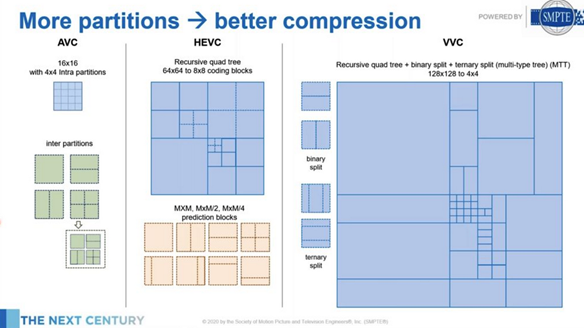
Understanding the Codecs
H.264 (AVC): The Universal Standard
H.264 remains the dominant codec in surveillance because it is:
- Universally supported
- Hardware accelerated across virtually all devices
- Computationally efficient
- Stable in mixed-vendor deployments
- Fully integrated into ONVIF and legacy VMS ecosystems
It is the codec that made megapixel IP video viable at scale. Even in 2026, most systems default to H.264 simply because it guarantees compatibility.
H.265 (HEVC): Better Compression, Mixed Adoption
H.265 typically provides:
- Roughly 40–50% bitrate reduction compared to H.264 at similar perceived quality (scene dependent)
This makes it attractive for:
- 4MP–8MP cameras
- 24/7 recording with long retention
- Bandwidth-constrained uplinks
However, adoption has been slower than expected due to:
- Licensing and patent pool complexity
- Historical browser limitations
- Decode performance variability across endpoints
- Integrator caution after prior “it works here but not there” playback issues
H.265 is common in modern cameras, but still not universally deployed as the default codec. Plus, some web browsers (Firefox) will not ship with H.265 decoders because of licensing, rendering them incompatible as surveillance web clients.
AV1: Next-Generation Compression
AV1 was designed as a modern, royalty-free codec focused on compression efficiency and long-term scalability.
As a working rule-of-thumb (content and encoder tuning matter a lot):
- AV1 can often achieve ~20–30% lower bitrate than H.265 at similar visual quality
- Compared to H.264, AV1 can often yield large total savings (commonly described as “half-ish” bitrate in many streaming contexts, but surveillance scenes vary)
Surveillance video is a special case: night noise, IR illumination, rain/fog, foliage motion, and busy scenes can change the outcome dramatically. Still, AV1’s core value proposition remains: more useful detail per bit.
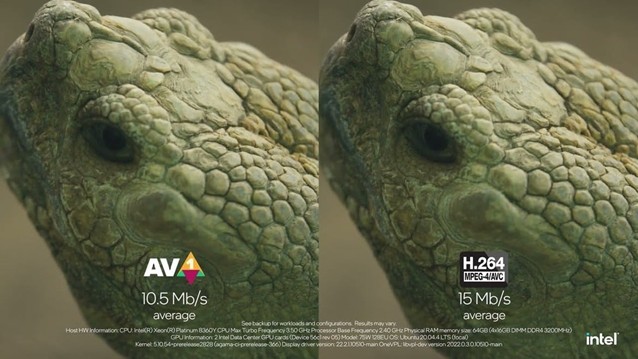
Bandwidth and Disk Savings: Why AV1 Matters
In surveillance, bitrate efficiency directly impacts:
- Cameras-per-uplink
- Retention days per TB
- Remote viewing stability
- Cellular / metered link costs
- Cloud storage bills (if used)
- Server ingest capacity
Conceptual Example (Same Scene, Same “Perceived” Quality)
Fill these values with your own lab results; the ratios are what matters.
- Camera: 5MP outdoor, moderate motion, day/night
- Target: similar forensic usability (faces, plates where possible, edges preserved)
| Codec | Typical Bitrate | Storage per Day (per camera) | Notes |
| H.264 | 4–6 Mbps | 43–65 GB/day | Baseline, most compatible |
| H.265 | 2.5–3.5 Mbps | 27–38 GB/day | Often ~40–50% lower than H.264 |
| AV1 | 1.8–2.8 Mbps | 19–30 GB/day | Often ~20–30% lower than H.265 |
At 50–200 cameras, even “just” 20% savings can mean:
- fewer disks,
- smaller RAID sets,
- lower power draw,
- longer retention,
- less WAN congestion.
Why AV1 Isn’t Prominent in IP Cameras (Yet) in 2026
AV1’s slow surveillance adoption isn’t because it’s a bad codec. It’s because the security surveillance in general has an ecosystem problem.
1) Camera SoC Cycles Are Slow (and AV1 Usually Needs New Silicon)
Most cameras rely on embedded SoCs with dedicated encoder blocks. AV1 is computationally heavier than H.264, and camera vendors generally won’t ship real-time AV1 unless it’s supported efficiently in hardware.
That means AV1 arrives on new camera chip generations, not as a simple firmware feature on older models.
2) Interoperability Defaults to the Lowest Common Denominator
Security deployments frequently mix brands, client devices, and VMS platforms. Integrators prefer the codec that:
- works everywhere,
- exports cleanly,
- plays back reliably on evidence machines,
- decodes on older operator workstations.
That codec is still H.264 (and increasingly H.265 where safe).
3) Decode Economics: Decoding Happens Everywhere
Encoding happens once per camera stream.
Decoding happens many times:
- recording servers (thumbnails, motion pipelines, exports)
- analytics servers (object detection ingestion)
- operator workstations (multi-tile view walls)
- web/mobile clients
- investigation playback PCs
If AV1 increases decode load (or requires hardware acceleration you don’t have), your TCO can go up even if bandwidth goes down.
4) “Smart Codec” Features Must Reach Parity
Many camera vendors use scene-adaptive encoding tactics:
- dynamic GOP structures
- motion-priority bitrate allocation
- noise management strategies
- region-of-interest behaviors (vendor specific)
AV1 needs to integrate with surveillance-specific encoding strategies without degrading forensic value or introducing odd motion artifacts.
5) Evidence Workflows Are Conservative
Surveillance video is used for investigations. Anything that complicates:
- export,
- chain of custody,
- playback on external machines,
- courtroom presentation,
- multi-agency sharing, slows adoption.
AV1 and Server-Based AI Analytics: Why It Can Improve Accuracy
This is where AV1 becomes more than a storage/bandwidth win.
1) Cleaner Frames at the Same Bandwidth Budget
AI models (person/vehicle detection, weapon recognition, behavior analytics) can suffer when frames have:
- macroblocking
- edge ringing
- smeared texture
- motion artifacts at low bitrate
If AV1 preserves edges and texture better at the same bitrate, models may see:
- cleaner silhouettes
- more stable bounding boxes
- higher confidence scores
- fewer false positives in complex motion scenes
2) Higher Effective FPS Under Constrained Links
If AV1 reduces bitrate meaningfully, you can sometimes choose to:
- increase FPS at choke points (doors, drive lanes)
- reduce dropped frames under congestion
- maintain higher resolution without saturating links
For AI, dropped frames and heavy compression often hurt more than people realize. More consistent frame delivery can improve tracking and temporal reasoning.
So, When Will VMS Systems See Widespread Use of AV1?
Expect a phased rollout, not a flip of a switch:
Phase 1: Single-Vendor Stacks First
Vendors who control both camera + VMS can adopt AV1 earlier because they can guarantee:
- camera encoding
- recording
- playback clients
- export behavior
Phase 2: “Supported When Available” in Major VMS Platforms
Major VMS vendors typically add AV1 as an optional stream type first, often with conditions:
- hardware decode recommended
- limited feature parity at launch
- specific camera firmware requirements
Phase 3: Multi-Vendor Default Adoption
This is the inflection point — when AV1 is safe enough that integrators can deploy it broadly without worrying about:
- playback breakage,
- export incompatibilities,
- client performance surprises.
A practical planning window is 2026–2028 for AV1 to move from “niche / premium” into “common checkbox,” with defaults following later. Axis is the first to do this, but it really hasn’t the attention in the industry it deserves. Hopefully others will follow soon (are you listening Hanwha, Avigilon, Bosch?).
Buyer Checklist: Evaluating AV1 Readiness
- Do your cameras support native AV1 encode (in hardware)?
- Does your VMS record AV1 without transcoding?
- Do your recording/analytics servers have AV1 hardware decode or enough CPU?
- Do operator workstations support multi-tile AV1 decode reliably?
- Do mobile/web clients support AV1 in your environment?
- Does your export/evidence workflow preserve usability and integrity?
Conclusion
AV1 can provide meaningful surveillance benefits:
- lower bandwidth
- longer retention on the same storage
- improved remote viewing stability
- higher effective quality at constrained bitrates
- cleaner frames for AI analytics (fewer artifacts, better detail retention)
The reason it’s not dominant in 2026 isn’t a technical flaw — it’s ecosystem inertia:
- slow camera silicon refresh cycles,
- interoperability conservatism,
- decode TCO,
- evidence workflow risk management.
The question isn’t whether AV1 will become mainstream in surveillance. It’s how quickly cameras, VMS platforms, and client devices converge on making AV1 the “boring” default.
Video Codec Comparison Table
| Codec | Year Introduced | Encode Resources | Decode Resources | Compatibility | Cost to Implement |
| H.264 | 2003 | Medium | Low | Extremely High (universal support across cameras, NVRs, browsers, GPUs) | Low |
| H.265 (HEVC) | 2013 | High | Medium | High (modern cameras, NVRs, GPUs; some browser limitations) | Medium–High (licensing fees + stronger hardware needed) |
| AV1 | 2018 | Very High | Medium–High | Growing (new GPUs, modern CPUs, limited camera-side hardware support) | Medium (royalty-free, but high compute + newer hardware required) |
Posted in: IP Video, Security Technology
Leave a Comment (0) →